
The AREAS Framework
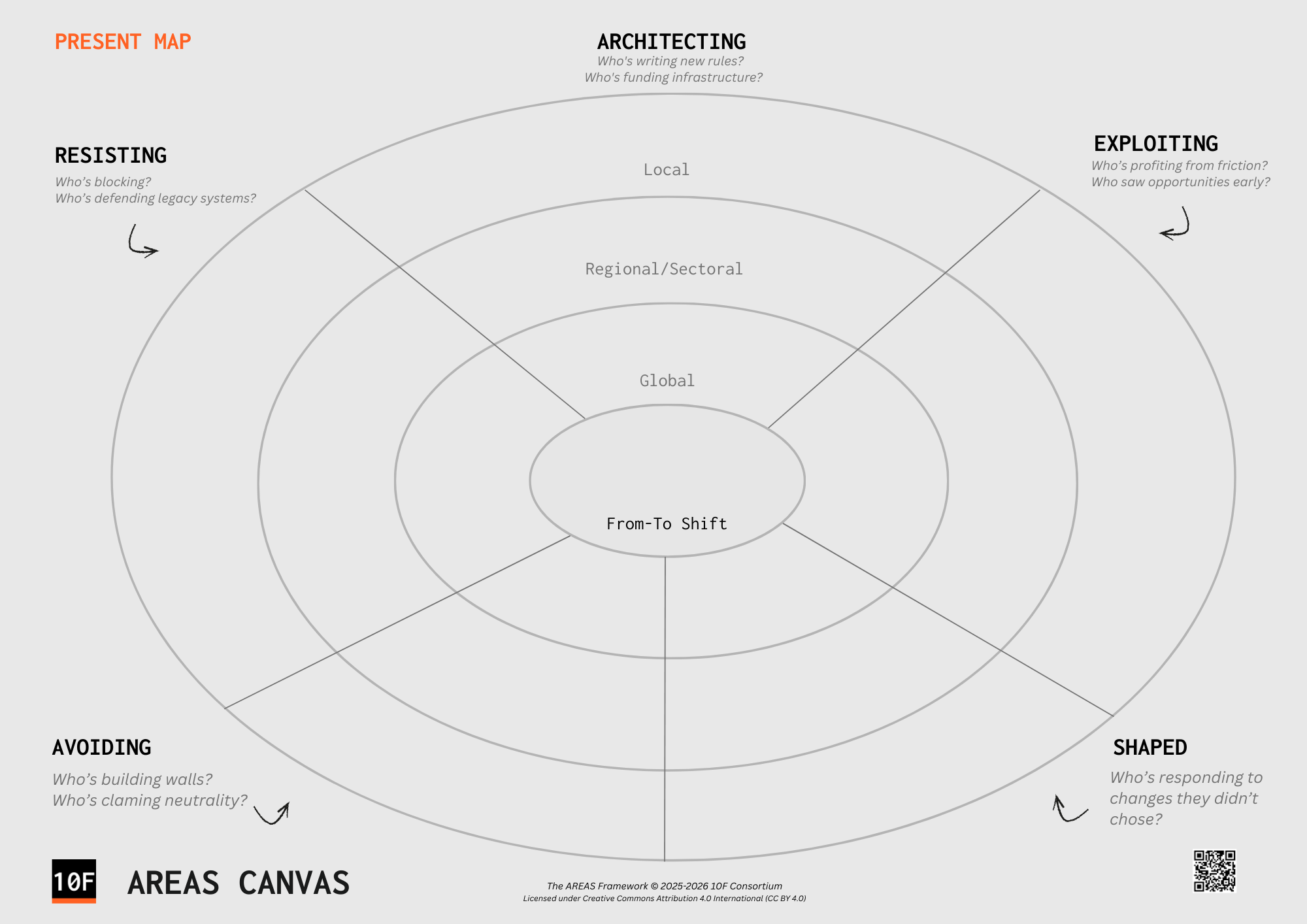
Download a prompt from the 10F GitHub repo and use your preferred AI to run a gap analysis using AREAS.
Why AREAS?
Most analysis of global systemic shifts relies on categories that don't necessarily address the dynamics of these shifts, but instead reach for the most convenient bundles of political, economic or cultural powers: geographic blocs, e.g. Global North/South, East/West, regime types, e.g. democracies/autocracies, market/state-led, or development categories e.g. developed/emerging economies.
These frameworks assume fixed identities and static positions and are often assigned by others rather than descriptive of individual context. They also assume fixed membership blocs or identity-based groupings that cross disparate countries which are experiencing similar dynamics. These categories fail when systems fragment and actors shift strategies based on circumstance rather than conviction.
The AREAS framework was developed for the 10F Project to focus on the less-defined shifts we see happening—transformations that lack clear names or established analytical frameworks. It describes where different actors stand relative to these shifts, without imposing predetermined categories or assuming fixed allegiances.
The framework emerged from observing that one actor might simultaneously resist one aspect of change while exploiting another. A government might architect new trade rules while avoiding climate commitments. A data broker might exploit regulatory gaps while being shaped by encryption standards. A religious institution might resist secularisation trends while exploiting digital platforms to expand global membership.
The framework applies across scales: nation-states and municipalities, large companies and local cooperatives, entire sectors (finance, agriculture, tech) and categorical roles (regulators, information brokers, civil society advocates) and groupings of individuals (voters, cultural societies, unions). It works whether analysing an industry, an institution, or a professional category.
The Five Positions in AREAS
AREAS is an acronym, made up of five major positions. These are:
Architecting
Those actively designing and building new systems in the face of transformation. These actors set rules, establish infrastructure and create governing mechanisms. They have and use or direct resources and authority to shape what replaces the old order. Tech platforms are architecting AI governance norms. Central banks are architecting digital currency systems. Industry coalitions are architecting carbon credit markets.
Recognition pattern: Who's writing the new rules? Who's funding the infrastructure? Who's convening the defining negotiations?
Resisting
Those who are working to prevent, slow, or reverse the transformation. These actors benefit from existing arrangements or believe the emerging system threatens their interests or values. Labour unions are resisting automation. Privacy advocates are resisting surveillance expansion. Fossil fuel interests are resisting energy transition.
Recognition pattern: Who's blocking implementation? Who's defending legacy systems? Who's organising opposition?
Exploiting
Those taking advantage of opportunities, gaps, or contradictions the transformation creates. This includes profiting from transitional chaos, seeing new opportunities early in emerging power structures and positioning to play valuable roles between fragmenting systems. Do you have something newly powerful actors need? Can you broker between competing power centres? Can you provide services that didn't exist before the shift? Exploitation isn't inherently negative but rather strategic opportunism, from arbitrage, to genuine value creation in newly relevant spaces.
Recognition pattern: Who's making money from the friction? Who saw the opportunity before others? Who's positioned as an essential broker between incompatible systems? Who's capitalising on newly scarce resources?
Avoiding
Those attempting to stay outside the transformation's direct effects. These actors seek insulation through geographic, economic, or institutional barriers. Credit unions are avoiding fintech disruption through community relationships. Local governments are avoiding federal policy through jurisdictional gaps. Communities are avoiding market integration through subsistence practices.
Recognition pattern: Who's building walls? Who's claiming neutrality? Who's maintaining old arrangements in isolated pockets?
Shaped
Those experiencing the transformation without adequate capacity to architect, resist, exploit, or avoid it effectively. These actors are forced to adapt to conditions created by others. Migrants whose options are shaped by border securitisation. Civil society organisations are shaped by funding shifts. Small businesses are shaped by platform economics. Being shaped isn't necessarily passive as it includes adaptation and resilience-building, but lacks immediate power to determine the system's direction.
Recognition pattern: Who's responding to changes they didn't choose? Who's adapting because alternatives disappeared? Who's navigating rather than steering?
Intellectual Foundations
AREAS draws from many allied analytical traditions. From scenario planning, it takes the principle that actors have agency and make choices based on perceived interests. From systems theory, it borrows the idea that positions are relational—architecting only makes sense relative to what's being built, resisting requires something to resist against. From political economy, it draws the insight that power isn't just held but exercised through specific actions. From network analysis, it recognises that actors occupy multiple positions simultaneously across different transformation dimensions.
Positions shift faster than identities. AREAS maps what actors do, not who they are. The framework deliberately avoids the teleological assumptions that may emerge from some schools of analysis. It acknowledges that outcomes emerge from strategic interaction, not predetermined relationships or roles.
Lastly, AREAS is not meant to be a grand theory, but as a fit-for-purpose tool to help shed light on the way power, or lack of power, interacts within major shifts. It’s intended as a framework for understanding, not necessarily for solving issues relevant to the users.
Active Application
For strategic planning: Map your organisation’s current position honestly. If you're being shaped, where might you exploit? What capabilities do you have that newly powerful actors need? If you're resisting, what resources would architecting require? Identify position shifts that expand agency.
For policy design: Identify who you need as architects, who will resist, who will exploit gaps in your design. Build policy that converts potential resistors into architects or closes exploitation opportunities before they open. Recognise that some exploitation creates system value—translation between incompatible standards, for instance.
For advocacy: Understand who's architecting systems you oppose. Target resistance where architects are vulnerable. Exploit contradictions in emerging systems while building capacity to architect alternatives. Consider whether you can position an essential broker between systems you can't control.
We’ve developed a tool to explore AREAS in depth and map future strategies around actor positioning, which is available for download. This tool is free to use and will be updated over time as we learn more about how it’s being applied.
Limitations and Considerations
AREAS provides snapshots, not predictions. The framework captures positioning at a moment in time, because positions can shift frequently. Actors move between architecting, resisting, exploiting, avoiding and being shaped—sometimes rapidly. This isn't a weakness. Tracking these position shifts reveals strategic momentum and serves as early warning of transformations in acceleration or stalling.
AREAS describes terrain, it doesn't prescribe moves. The framework shows you the strategic landscape so you can plan based on your capabilities, constraints and goals. What position you should take depends on factors the framework can't assess: your resources, values, risk tolerance and organisational culture.
Classification ambiguity reflects strategic reality. The boundaries between positions aren't always sharp because actors often position themselves ambiguously or occupy multiple positions simultaneously. The framework's flexibility captures this complexity rather than forcing false precision.
AREAS emerged from Western strategic planning traditions. It works best for analysing actors making deliberate choices within or between competing systems. The framework may not capture collective decision-making models, positioning strategies rooted in different cultural logics, or approaches that reject the framework's underlying assumptions about agency and strategic choice. Users should recognise these boundaries and supplement AREAS with other analytical approaches when working across different contexts.